Thursday, June 12, 2014

The Rules for Fanorona

The object of the game is to win by capturing all of your opponents pieces.  Draws by repetition are possible.


Arrange the 22 pieces for each player as shown. 

Moving: White moves first.  Pieces are moved by sliding one space along one of the the lines.  Note that some points lie on diagonal lines, while others have only horizontal and vertical directions.

Capturing:  you can capture a line of your opponent's pieces by approach by moving toward them into the adjacent space, orby withdrawal by starting in the adjacent space and moving directly away from your opponent's piece.   In some positions, you could capture either way, and you must choose one or the other.

A Turn:  consists of either a single, non-capturing move, or a sequence of capturing moves.   If any capturing moves are possible anywhere on the board, then a capturing move must be made.  If multiple captures are possible, you can choose which to do.  Subsequent captures on the same turn are optional.    Second and subsequent captures in the same turn are subject to some restrictions:

  • you must keep moving the same piece
  • you cannot return to any space twice
  • you can't move in the same direction twice in a row
Elementary observations:

In the opening, many captures are possible and so a lot of pieces will be eliminated very quickly.

The basic tactics are to squeeze your opponet's pieces so he is forced by zugzwang to move toward you, or to set up sacrifices where a mandatory capture is ultimately disadvantageous.


[Source: BoardSpace]

Four seasons chess

 One of the first European books on games was Libro del Acedrex, commissioned by the Spanish king Alphonse the Tenth. The book contains several interesting historical games, including Four Seasons Chess--a variant for four players--and Grande Acedrex--a variant for two players.


The following description is based on information from Murray's and Gollon's books. The original Spanish name for Four Seasons Chess is Acedrex de Los Quatros Tiempos.
As its name implies, the game is a competition between four players, each representing one of the seasons. Moreover, each player's colour represents one of the four elements and a humour. Green represents spring, air, and blood; Red represents summer, fire, and choler; Black represents autumn, earth, and melancholy; White represent winter, water, and phlegm.

Board and opening setup

The game is played on an 8x8 square board having two diagonal lines that cross the eight central squares. One diagonal crosses c3, d4, e5, and f6; the other crosses c6, d5, e4, and f3. Whether or not these diagonals influence play is not known. One may chose to ignore the diagonals or allow them to divide the board into fields which may not be crossed by any piece.

The opening setup is as follows:


Red: King a1; Rook b1; Knight a2; Bishop b2; Pawns a3, b3, c1, c2.
Black: King h1; Rook g1; Knight h2; Bishop g2; Pawns g3, h3, f1, f2.
White: King h8; Rook g8; Knight h7; Bishop g7; Pawns h6, g6, f8, f7.
Green: King a8; Rook b8; Knight a7; Bishop b7; Pawn a6, b6, c8, c7. 

Moves of pieces

King, rook, and knight move as in orthodox chess. The bishop leaps to the second diagonal square. The pawn moves as in orthodox chess but without the initial double step. The direction of a pawn's movement is as expected. For instance, red pawns on a3 and b3 move upward while red pawns on c1 and c2 move to the right.

When a pawn reaches its last rank, it promotes to a general. A general moves one square diagonally.

Other rules

Green moves first and play progresses anti-clockwise (green, red, black, white). Both mate and stalemate constitute a loss. A mated player's king is removed and his pieces taken over by the mating player. All of astalemated player's pieces are removed from the board. The last remaining player wins the game.

Variant with dice

A 6-sided die may be used to determine which piece a player may move. Rolling a 6 allows the king to move, a 5 the queen, a 4 the knight, a 2 the bishop and a 1 a pawn. When a move is not possible, the turn is lost. The game can also be played with two dice, which often allows the player to chose between two numbers. However, the diceless version of the game seems to be the more interesting.

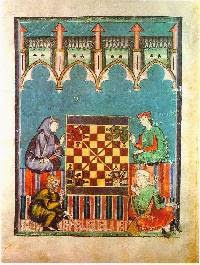
A picture from King Alfonso's book


The following picture is from the Libro del Acedrex. Click on the picture to see it in larger size.

A facsimile of King Alfonso's book is available at EDILÁN (link).

Written by Hans Bodlaender. Edited by John William Brown.

Medieval Chess Rules

The king, rook and knight could move as in modern chess. The pawns also moved the same except that on their first move they could only travel one square. The bishop moved diagonally as today, but two squares, and they could jump pieces. The queen could only move diagonally one square at a time.

Stalemate and Checkmate were the same as today, though Baremate also existed if a king was left with no pieces.

Tuesday, June 3, 2014

Hound and Hare


Rules:

Place twelve counters on the top two rows of the board, and the ends of the third row. These are
the Hares. Place one counter in the centre of the board. This is the Hound. The Hares are trying
to pen in the Hound so he can’t move. They can move one space at a time along the lines. The
Hound is trying to eat the Hares. To eat a Hare the Hound hops over it like in checkers. Otherwise
the Hound moves one space along the lines just like the Hares. The Hound does not have
to jump.

Fox and Geese


Rules:

Place thirteen counters on the top three rows of the board. These are the Geese. Place one counter in the centre of the board. This is the Fox. The Geese are trying to pen in the Fox so he can’t move. They can move one space at a time along the lines in any direction. The fox is trying to eat the Geese. To eat a Goose the Fox hops over it like in checkers. The fox can jump over more than one Goose per turn. Otherwise the Fox moves one space along the lines just like the Geese. The Fox does not have to jump, and goes first.

Variations:

The Geese can only move straight up, down or side to side; not diagonally. If played this way place two
more Geese on the board.

The Geese move first.

The Fox starts on any open space.

Monday, May 19, 2014

Alquerques


Rules:

Each player had twelve pieces places as in the illustration above. Pieces move on space at a
time following the lines. To capture a piece you must jump over it (like in checkers). Multiple
captures are possible, and mandatory. If you could have caught a piece, but did not, this is a
huff. If your opponent notices the huff, he can remove your piece that should have jumped. Play
ended when one player lost all their pieces.

Wednesday, May 7, 2014

The ancient game of GO

The ancient game of GO

by Magnus Strykewind

The true origins of the game (called Weiqi in China, Baduk in Korea, and often called iGo (ee-go) in Japan) are lost in the mists of time. Many believe the game was created as a teaching tool after the ancient Chinese Emperor Yao (2337-2258 BC) designed it for his son, Danzhu to learn discipline, concentration and balance. Other believe it was the invention of Chinese warlords and generals, who used pieces of stone to make attacking positions. Some believe it was used for astrological divination.

The game is played on one of 3 board sizes: 9x9, 13x13, and 19x19. Unlike many board games, the pieces are played on the intersecting lines rather than in the squares. So a 9x9 board is 9 points long, and 9 points wide for a total of 81 points to place stones on. The Largest board, 19x19 has 361 points (including the sides) which also happens to be the same number of days in the ancient Chinese calender. A 19x19 game takes about 1 hour to play, a 13x13 takes 30 minutes and a 9x9 is about 15 minutes.

The objective is to surround more empty points, known as Territory, on the board than your opponent. 2 players take turns placing black and white stones on the intersecting points on the board. Black always goes first. A stone is “captured” when it has no empty points (Liberties) next to it. Two or more stones of the same color share their liberties when the are connected. Captive stones are removed and kept by the opponent. Each prisoner is worth 1 point. Each empty point of surrounded territory is worth 1 point.

A stone cannot be moved once it has been placed, unless it is captured and removed from the board. A stone cannot be placed on a point where it has no liberties, unless doing to captures enemy stones. A stone cannot be placed on a point that repeats the same move infinitely. A stone must be played elsewhere before repeating the previous move. Since black always plays first, white gets extra points to offset this advantage called “Komi” points. Komi is a recent change to the game, less than 2 centuries ago. At first it was 4.5 points, but increased over time to 5.5 and finally to 6.5 for a full 19x19 game. Before then white received nothing, and was always at a disadvantage.

No two players have exactly the same skill level. So in order to make a game between a stronger and weaker player more fair, handicaps may be used. The stronger player plays white, and the weaker player plays black. Black is given additional stones at the start of the game to offset the difference in strength. In the international world of GO, player's strength is represented by a rank number. There are 2 tiers, Kyu and Dan. Kyu starts at 30 and decreases as the player's strength increases. After 1Kyu comes 1Dan (Shodan) and then increases to 9Dan.  For every point of difference, Black should receive 1 extra stone. So a 15Kyu against a 12Kyu would get 3 stones, and a 2Kyu against a 3Dan would get 4 stones If you do not know your strength rating, playing an even game will determine what an appropriate handicap would be. For every 10 points (rounded down) that 1 player beats another by, 1 stone is considered fair. So if John loses to Jane by 30 points, John should get a 3 stone handicap to make it an even match.

While the game itself is ancient, its popularity today has never been higher. The internet has brought the game to a truly global level. With thousands of games being played by people all around the world every day, and it's popularization through the hit anime series “Hikaru No. Go!” international interest in the game has exploded. In Asia many countries are home to professional leagues, publications, Go salons, international amateur tournaments, training institutes, personal tutors and an ever growing fan base. In North America, The American Go Association (AGA) and the Canadian Go Association (CGA) are the authorities on the game. With hundreds of members, and tournaments organized both in person and online, both associations are leading the charge to spread the word and popularity for the game.


While there are many places you can play Go online, by far the most popular (and in my opinion the best) place is the Kiseido Go Server. You can learn more about the game, play against other players from around the world, play against computer AI opponents of varying difficulty, find out what your strength ranking is,  even participate in official tournaments held by the AGA and CGA for international rankings. And yes... There's an app for that. KGS provides a mobile version of their program Cgoban3 on google play for Android smartphones and tablets (Sorry iPhone users). There are also many other apps on all platforms that allow you to play the game against the computer AI known as GnuGo, the same AI used by KGS and just about everyone else for computer Go. Which allows you to set the difficulty level from pants-on-head stupid, to 9Dan legendary.